
Twenty-four million clones. Two hundred fifty-eight thousand stars on GitHub. A valuation of 1.5 billion dollars. At first glance, the numbers of Nous Research do not tell the same story as its organization: about twenty people, no giant data center, no frontier model with several hundred billion parameters. The software that produces this excess is a command-line agent, distributed for free, that anyone can install, modify and host.
This anomaly is the subject. Nous Research does not sell a model: it sells a relationship of trust in an agent. Its thesis boils down to one sentence, repeated for three years in every form: the people who use an AI must keep control of it. Everything else (the Hermes family of models, the agent, the Nous Portal subscription, the Psyche training network) follows from this promise. And it runs into a question the industry has not settled: can you sell trust when you give away the code?
AI as a public good
The name is a program. Nous is the Greek word for intellect, the mind that perceives directly. Hermes, the messenger of the gods, became the agent that executes. Psyche, the soul, gave its name to the distributed training network. This coherent mythology is not just a branding affectation: it tells of a philosophy, intelligence as a shared faculty, and not as industrial property.
Nous Research was born in 2022 from a collective of researchers and tinkerers gathered on Discord and X, around an intuition: good synthetic datasets can produce excellent models without industrial means. The collective became a company in 2023, with four founders: Jeffrey Quesnelle, Karan Malhotra, Teknium and Shivani Mitra. Dillon Rolnick joined them the same year, first as director of operations, before becoming CEO.
The company's doctrine is called alignment on the user. Where the large laboratories train their models to refuse, to qualify and to protect themselves legally, Hermes is trained to embrace the point of view of the person using it. "Neutrally aligned," says the internal formula: the model must follow the worldview of its user, not that of the company that made it. It is a philosophical position, a commercial argument and a source of controversies. It is also what distinguishes Hermes from yet another Llama variant.
Nous Research is nevertheless not a frontier laboratory in the sense of OpenAI or Anthropic. Its original expertise is post-training: starting from a solid open base (Llama yesterday, Seed-OSS today) and transforming it into an obedient, steerable assistant capable of calling tools. "We understood that post-training was the layer where we could have the most impact," summarizes the announcement letter of the series B. An elegant way of saying that the laboratory built its advantage on the layer that the giants consider a detail.
From Discord to Series B
It all starts with a viral success. The first Hermes, a fine-tune of LLaMA, spreads in a few days. No one really knows who is behind it: it is the spirit of the collective. Then comes the founding controversy: the benchmark scores look too good to be honest. Accused of training their models on the tests, the founders respond that they did not know what these benchmarks were. Independent verification proves them right. The anecdote says something about the house: build first, optimize later, and sometimes not optimize at all.
2023 is the year of structuring. The collective incorporates, raises a first round from crypto investors and business angels, and publishes YaRN, a context extension method since adopted by Meta and DeepSeek. Hermes 2, then Hermes 3, establish the family in the open source ecosystem; it becomes the default model of agent frameworks such as Eliza.
2024 broadens the ambition. With Diederik Kingma, co-inventor of the Adam optimizer and cofounder of OpenAI, Nous Research publishes DeMo, then DisTrO, methods that drastically reduce communications between GPUs. In December, the lab trains a 15 billion parameter model across 11,000 nodes spread over several continents. Meanwhile, Karan Malhotra's WorldSim experiment (getting Claude out of its assistant persona) goes viral and earns the lab unexpected media coverage, notably in the New York Times.
2025 accelerates: a $50 million Series A led by Paradigm, testnet of the Psyche network, release of the Hermes 4 family (14B, 70B, 405B), then of Hermes 4.3, the first production model post-trained entirely on Psyche. 2026 is the year of scaling to the general public: Hermes Agent in February, a global hackathon, then a $90 million Series B in October.
Key dates
- 2022: Collective on Discord and X. Distillation of the first LLaMA, birth of the Hermes family.
- 2023: Hermes 1 goes viral. Publication of YaRN. Incorporation and first funding round.
- 2024: Hermes 2 and 3. DeMo and DisTrO with Diederik Kingma. WorldSim. Demonstration of a 15B across 11,000 nodes.
- 2025: $50M Series A (Paradigm). Psyche testnet. Hermes 4, then Hermes 4.3 trained on Psyche.
- 2026: Hermes Agent (February, MIT). 258,000 GitHub stars. $90M Series B (October).
The stack, brick by brick
Each brick in the stack answers the same question: how do you get an AI to work on real tasks without entrusting your data, memory and tools to a single intermediary?
Hermes, the recipe
Hermes is less an architecture than a recipe: start from a solid open base, post-train it on synthetic data and carefully curated instruction sets, then tune the behavior so that it follows the user rather than a company's instructions. Hermes 1, 2 and 3 built this reputation on Llama; Hermes 4 crossed a threshold in August 2025 with three sizes (14B, 70B, 405B) and a hybrid reasoning mode.
The figure the lab highlights is RefusalBench, a test that measures a model's ability not to refuse a legitimate request. Hermes 4 scores 57.1% on it and claims first place, with 96.3% on MATH-500 in reasoning mode. Hermes 4.3, published in December 2025, pushes the logic further: only 36 billion parameters, a 512,000-token context, and proof that a model trained in a distributed way can match, or even surpass, its centralized equivalent. More than 50 million cumulative downloads on Hugging Face, according to figures relayed by the specialist press.
Hermes Agent, the product
Published in February 2026 under the MIT license, Hermes Agent is a command-line agent designed to live on the user's machine or on a server. Its difference comes down to three ideas: persistent memory that survives restarts, skills that the agent writes itself after solving a problem, and a gateway that connects it to more than twenty messaging platforms (Telegram, Discord, Slack, Signal, WhatsApp, email, Matrix, Teams).
The agent is deliberately agnostic: it works with Nous Portal, OpenRouter, OpenAI, Anthropic, Google or any compatible endpoint, and can run locally, in Docker, over SSH, on Daytona, Modal or Vercel Sandbox. You can therefore change models without losing your memory or your skills: a choice that says a lot about the strategy, retaining the user through the accumulation of context, not through model lock-in.
Nous Portal, the checkout
Nous Portal is the company's recommended way to run Hermes Agent. For a subscription, the user gets access to more than 300 models (Anthropic, OpenAI, Google, DeepSeek, Qwen, Kimi, GLM, MiniMax, xAI, NVIDIA) and a "Tool Gateway" that bundles web search, image generation, text-to-speech, a cloud browser and an execution sandbox. A single OAuth login replaces half a dozen accounts and API keys.
This is the lab's economic pivot: Nous Research does not bill for its own models, but for the infrastructure that makes it possible to orchestrate those of others. A position as the "Switzerland of models" that turns stated neutrality into recurring revenue, and that avoids depending on the commercial success of a single model family.
Psyche, the disruptive bet
Psyche is a distributed training network: rather than renting a giant cluster, it coordinates machines spread across the internet, linked by DisTrO, a gradient compression method that reduces the volume of data exchanged between GPUs. Coordination and traceability go through the Solana blockchain; the gradients themselves travel over a dedicated peer-to-peer network.
The December 2024 demonstration (15 billion parameters trained on 11,000 nodes), then the May 2025 testnet and the training of Hermes 4.3 on 24 nodes at 144,000 tokens per second convinced part of the ecosystem. One question remains open: no one has yet publicly shown distributed training at the scale of frontier models, with the tens of billions of dollars that implies.
Hermes for Businesses, the test
Announced alongside the Series B, "Hermes for Businesses" is meant to transpose the promises of the consumer agent into the corporate world: choosing models according to budget and data sensitivity, compartmentalization, governance of internal knowledge, support and deployment. The message is explicit: a company must own its intelligence stack, not rent it. A consumer mobile app is also announced, a sign that Nous Research does not want to sacrifice its individual grounding.
Give the software, sell the trust
The software is free; trust, convenience and governance are paid for. This is the formula that Nous Research has been deploying since 2025, and which explains both the very rapid growth of its audience and the reticence of some observers.
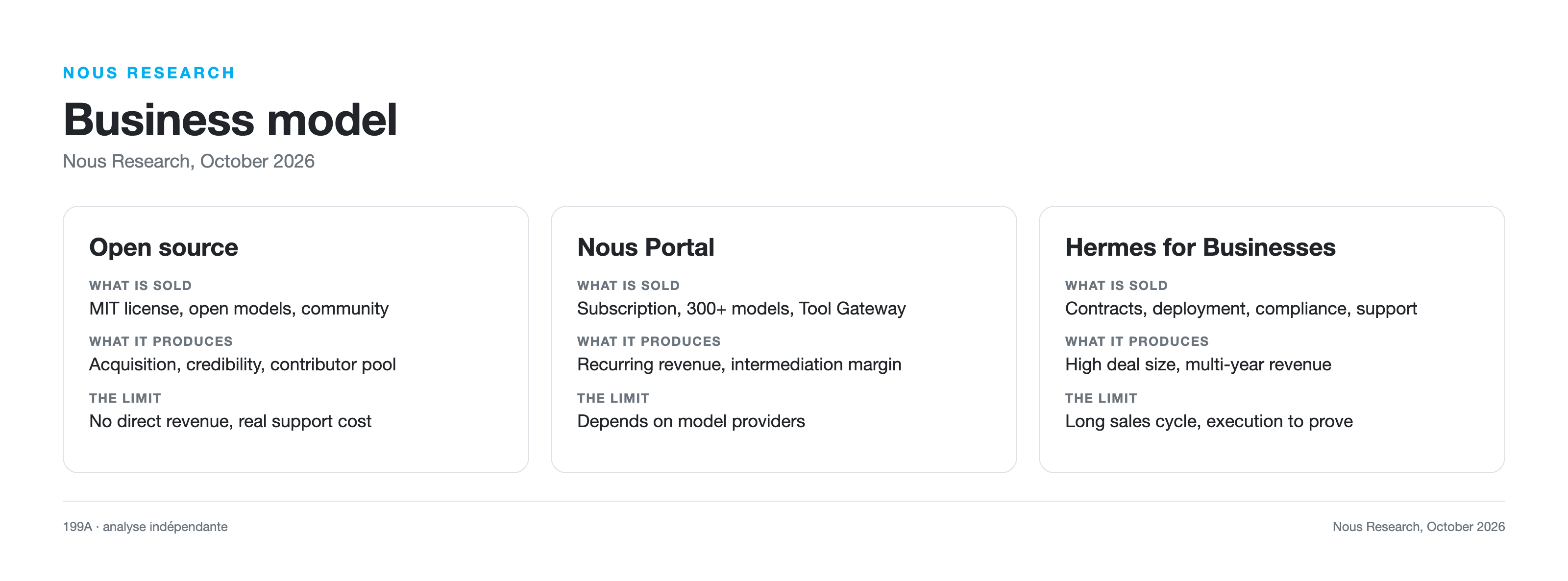
The sequence is classic in open source software (give away the core of the product to create a standard, sell the operation), but here it is applied to an agent, that is to say to an object that accumulates context and becomes more useful the more it is used. Every week spent with Hermes Agent increases the cost of leaving, without the company needing to lock anything down.
The known figures trace an impressive and fragile trajectory. Annualized revenue was about 36 million dollars in mid-September 2026, according to the Wall Street Journal; management is aiming for more than 100 million by the end of 2026. At a valuation of 1.5 billion dollars, the multiple exceeds 40 times annualized revenue: a level that assumes perfect execution and immediate acceleration of enterprise contracts.
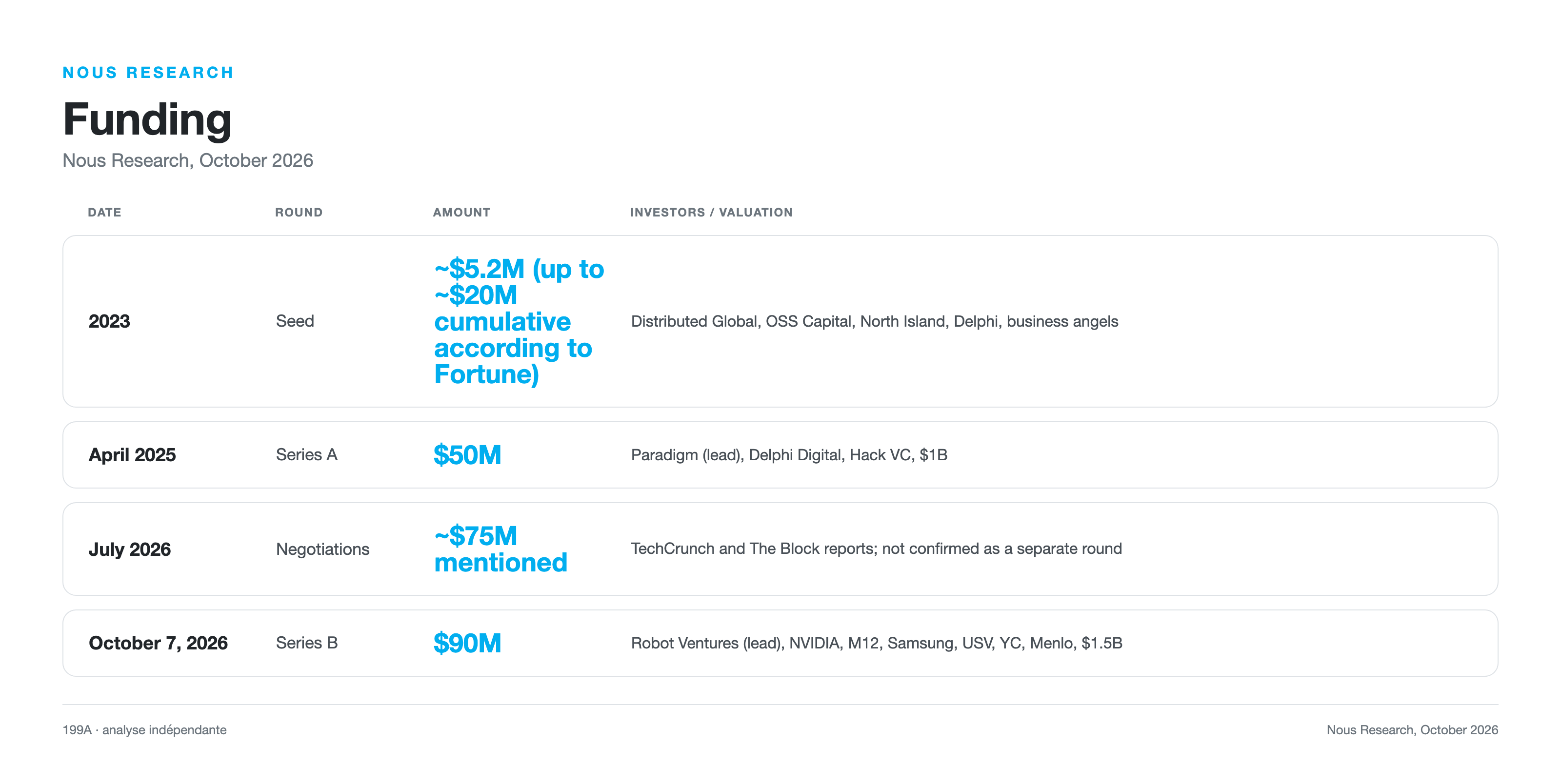
Total raised: 158 million dollars according to the company, 165 million according to some databases that count seed rounds separately. The crypto press mentioned a "token" valuation of 1 billion dollars for the series A, which explains the differences in interpretation between the crypto press and the tech press.
"In some ways, 90 million dollars is modest in modern financing."
, Dillon Rolnick, series B announcement letter, October 7, 2026
Four structural risks threaten this arrangement. Cannibalization: an MIT agent can be forked, resold or integrated for free by a competitor; protection does not come from the code but from the brand, the community and the quality of execution. Supplier dependency: the Portal resells access to models that do not belong to it, and a price increase is passed on immediately. Inference costs: an agent that runs continuously and calls tools is expensive, and the promise of "less than 100 dollars per day" must hold up against intensive users. Enterprise sales, finally: hiring a legal director and "forward deployed" engineers is not enough to reassure a CISO; compliance is a long-term undertaking.
The numbers, and what they don't say
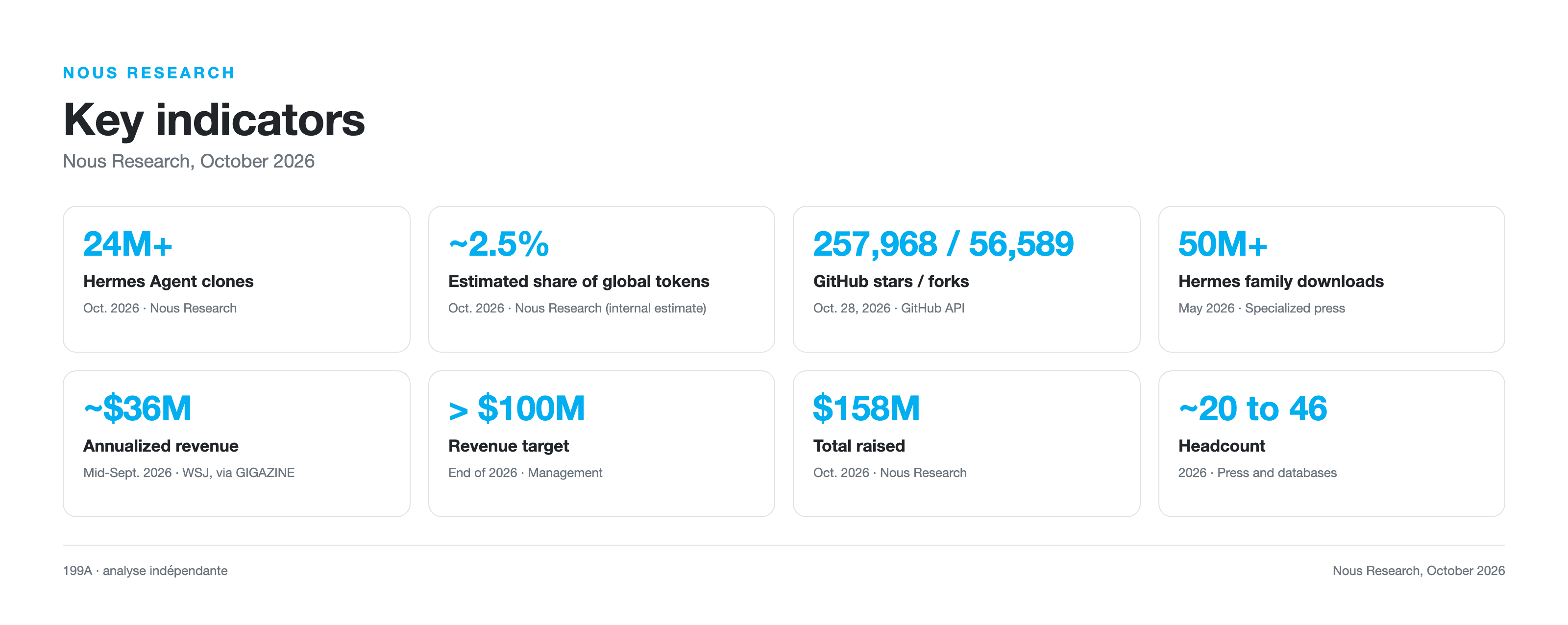
These numbers tell the story of a rare adoption for a command-line tool. Hermes Agent has no advertising campaign and no consumer app: it spread through GitHub, X, Discord and developer word of mouth. The most telling metric may not be the number of clones, but the speed at which the repository passed 140,000 stars in three months after the public launch.
They must nevertheless be read with caution. The number of clones measures downloads, not active users; the share of global tokens is an internal estimate; GitHub stars measure attention, not revenue. The only third-party financial data point (36 million dollars in annualized revenue) remains modest relative to the valuation, and that is precisely the bet of the Series B.
Five faces
Nous Research does not publish an org chart. Titles change quickly in a company of this size, and some biographies are reconstructed from third-party sources. The five profiles that follow do not claim to describe a hierarchy: they describe a distribution of roles, the one that explains the laboratory's trajectory and the nature of Hermes Agent.
Dillon Rolnick, the operator from finance
He has neither a doctorate nor a researcher's background. That is precisely what makes him useful: Dillon Rolnick is the translator between the laboratory's culture and the demands of capital.
A Vanderbilt graduate in 2017, he began his career as a currency market maker at Effex Capital (forex, metals, futures, contracts for difference, crypto). In 2019, he founded Crysknife Capital, a vehicle named after a weapon from Dune, specializing in the acquisition and quantitative valuation of claims arising from litigation. He then spent time at a large venture capital fund as head of research, before joining Nous Research in 2023.
He joined as chief operating officer (he still introduces himself that way in May 2025 on the ThursdAI podcast) and became chief executive as the company took shape. He is the one who carries the public message: Akash Accelerate 2025 conference, appearance on TBPN at the launch of Hermes Agent in March 2026, Wall Street Journal article in October. His argument is always the same: open AI is cheaper, more auditable, and competition benefits users first.
His leadership style can be read in his Series B announcement letter, where he calls 90 million dollars a "modest" sum. Behind the phrase, a trader's method (look for the mispriced asset, get there before the crowd) applied to a conviction: openness is undervalued by the market.
"One principle has remained constant since the first version of Hermes: the people who use an AI system must keep control of it."
, Dillon Rolnick, Series B announcement letter, October 7, 2026
Jeffrey Quesnelle, the architect
He is the cofounder cited when there is a need to prove that Nous Research does research, and not just noise. Jeffrey Quesnelle is the man behind the two innovations that make Hermes Agent possible: long context and distributed training.
Trained in computer science and mathematics at Oakland University, then holding a master's degree from the University of Michigan-Dearborn, he led software development at Intrepid Control Systems from 2017 to 2022, before becoming a principal engineer at Eden Network, a blockchain infrastructure company. This background as a systems builder, more than as an academic researcher, explains his manner: short papers, implementations that run.
In 2023, he coauthored YaRN, a method that extends the context window of models from 8,000 to 16,000 tokens up to 128,000 tokens at limited additional cost. Cited more than a hundred times, adopted by Meta and DeepSeek, it became a de facto standard. In 2024, he coauthored DeMo with Diederik Kingma, then DisTrO, which reduce traffic between GPUs and make distributed training economically viable. This is the basis of Psyche.
He presents this work in demanding formats: a two-hour conversation with Sina Habibian in March 2025 on Fourier transforms applied to gradient compression, the mathematics of distributed training and theories of mind. His intellectual signature is "neutral" alignment: a model must embrace its user's worldview, not that of the company that made it.
Karan Malhotra, the philosopher of behavior
A degree in religion and philosophy, a stint in neuroscience, and responsibility for what the Hermes models dare to say, or refuse to say.
Karan Malhotra studied religion and philosophy at Emory University, then worked as a machine learning researcher at the Stanford Brain Stimulation Lab, where he studied the effects of non-invasive brain stimulation. The leap to language models is not a break: in both cases, it is about understanding how a complex system changes its output when its input changes.
A cofounder in 2022, he became Head of Behavior, the one who defines the personality, values and steerability of the models. He is the one who publicly owns the "uncensored" doctrine: a model that refuses, hesitates and treats the user like a suspect is not safe, it is useless. He also defends the use of blockchain in Psyche, not out of ideology but for its incentive and traceability properties against the risk of data poisoning.
His WorldSim experiment in early 2024 remains a pivotal moment: by asking Claude 3 Opus to step out of its assistant persona and become the command-line interface of a simulated reality, he demonstrated that an AI contains a model of the world far richer than the products let on. The episode went viral and installed the laboratory in the public debate on the nature of model behavior.
"Intelligence must not be monopolized by companies. Like water and air, it must be a public good accessible to all."
, Karan Malhotra, interview relayed by Plain AI, May 2026
Teknium, the anonymous craftsman
No one knows his face; everyone knows his models. Teknium is the craftsman of the Hermes family, the one who turns an open base into an obedient and pleasant assistant.
He works under a pseudonym, which does not prevent credibility or influence: his account and his publications on Hugging Face are followed by part of the open source community. Before Nous Research, he spent time at Stability AI. He is the author of the GPTeacher dataset, which was used to train the very first Hermes, and the main person responsible for the post-training of Hermes 2, 3 and 4, including the 405B model released in August 2025.
His daily work, as he describes it, mixes data engineering, training infrastructure, evaluations and alignment research. It is painstaking work: building instruction sets, filtering, balancing, measuring refusals, starting over. The perceived quality of a Hermes model, its way of following a precise instruction without drifting, owes more to this discipline than to a spectacular architecture.
His anonymity is consistent with the culture of the place: what matters is the published weights, the model cards and the datasets, not the personality of their author. His line, during a question-and-answer session in 2025, sums up the mix of seriousness and provocation that characterizes the house.
"I'm the head of post-training at Nous Research, and you know what, I might be an AGI."
, Teknium, question-and-answer session, 2025
Shivani Mitra, the discreet bridge
The least visible of the four founders is also the one who connects the laboratory to the world of crypto capital, the material condition of its independence.
Shivani Mitra is one of the four original founders. In the rare biographies available, she is described as a researcher and investor present in the Ethereum, NFT and open source communities, and as Managing Partner of the Shiro San Fund within Global Asset Capital. At the laboratory, her role concerns research leadership, strategy and the long-term vision of open AI.
Her contribution is less visible than that of a CTO or a spokesperson, but structuring: she is the part of the team that speaks the language of crypto funds (Paradigm, Delphi Digital, Hack VC, then Distributed Global) while holding the line of a "serious" laboratory, in the word repeated by Karan Malhotra. This dual competence explains why Nous Research was able to raise from crypto investors without being reduced to a token project.
Her discretion is real: we have not identified any long public interview concerning her. The biographical elements above come from professional databases and press profiles, and should be read as such.
Around the five
Hervé Bizira leads the adoption of Hermes Agent among large organizations: security, governance, deployment. His career path goes through Verizon Media, within the RYOT content studio, and through the technical direction of an investment fund, with training at the University of Waterloo. Since 2026, he has been the face of the enterprise shift: in September, he spoke at the World Congress in San Jose on trust and speed in the age of agents, and M12, Microsoft's fund, cites him alongside Dillon Rolnick at the time of the Series B. His presence signals that Nous Research no longer sells only a tool to developers, but a promise of compliance to buyers.
Tristan Chaudhry is, according to an investigation by Plain AI, a cofounder who has remained in the shadows. He reportedly met Jeffrey Quesnelle at a networking event in San Francisco, after a career path from former Chipotle restaurant manager to self-taught data scientist. He defends a "People's AI" vision and a theory of security through community rather than control: "The goal of AI is not to become an AI god, but to become more human," he reportedly told Mercury. His biography is not confirmed by the company and does not appear in the official list of the four founders; it nevertheless sheds light on the culture of the original collective.
Diederik Kingma is the external scientific guarantor. A cofounder of OpenAI and co-inventor of the Adam optimizer, he coauthored with Nous Research the DeMo and DisTrO works that form the basis of Psyche. He is not an employee of the company, but his signature lends credibility to the laboratory's ambition among researchers and investors, and recalls that Nous Research remains, above all, a laboratory that publishes.
A commando culture
Nous Research cultivates a commando aesthetic: small team, remote work, rapid iterations, a taste for secrecy and provocation. The careers page copy, a pastiche of expedition announcements, embraces the "mission" angle rather than the "career" one. In practice, this translates into generalist profiles, capable of moving from a research paper to deployment infrastructure, and a constant presence on Discord, GitHub and X.
"Good salaries, long months of total focus, constant danger, with honor and glory in case of success."
, Nous Research careers page
The community is treated as a strategic asset, not as a marketing channel. Models are released with their cards, their datasets and their evaluations; external contributions are integrated; hackathons serve to discover real uses before turning them into products. This is what allows a team of about twenty people to keep up a publication pace that would make organizations ten times larger pale.
The flip side is structural: a small team concentrates risk. Dependence on a few key people is strong, the compliance function is recent, and the promise of global enterprise support rests on headcount that has not yet been sized for it. The Series B precisely finances this transition: hiring "forward deployed" engineers, a legal director, designers and researchers.
Six contradictions
The success of Nous Research does not come without tensions. Here are six, which structure the conversations of investors, researchers and enterprise buyers.
1. "Uncensored": product or risk? RefusalBench, which measures the ability not to refuse, is an assumed counter-benchmark: it turns inverted compliance into a sales argument. Critics see in it a shift of risk toward the user and an open door to problematic uses. Nous Research's response comes down to two points: the auditability of open weights is worth more than the opacity of filters, and a model that refuses too much becomes unusable for researchers as well as for enterprises.
2. Crypto, Achilles heel or advantage? Psyche relies on Solana, and the Series A valuation was presented as backed by a token. Part of the AI ecosystem sees in it a risk of conflict of interest and volatility; another sees it as the only way to finance distributed training at large scale. Karan Malhotra himself acknowledged that crypto offered "a lot of room for scams," before embracing the bet on traceability.
3. Open source and enterprise: the MIT paradox. How do you sell "Hermes for Businesses" when the agent is free and forkable? The answer is classic: you sell support, compliance, integration and peace of mind, but it has not yet been demonstrated at scale. The risk: that enterprise customers prefer to pay an integrator rather than the vendor itself.
4. Dependence on others' models. Hermes is a post-training: without quality open bases (Llama, Seed-OSS), the recipe does not work. Meta could stop publishing its weights; other providers could restrict their licenses. This is precisely what motivates Psyche and, eventually, in-house models, but the road is long.
5. Valuation before revenue. 1.5 billion dollars for about 36 million dollars in annualized revenue, or more than 40 times sales. The multiple is justified by growth and by the Psyche option; it leaves no margin for error. A slowdown in adoption or a failure of the enterprise shift would be costly.
6. The measurement of traction. 24 million clones, 2.5% of global tokens, 258,000 stars: these indicators measure attention and usage, not captured value. None is audited by a third party. The usual discipline (separating traction, revenue and retention) remains essential to evaluate the company.
Facing OpenClaw and the closed giants
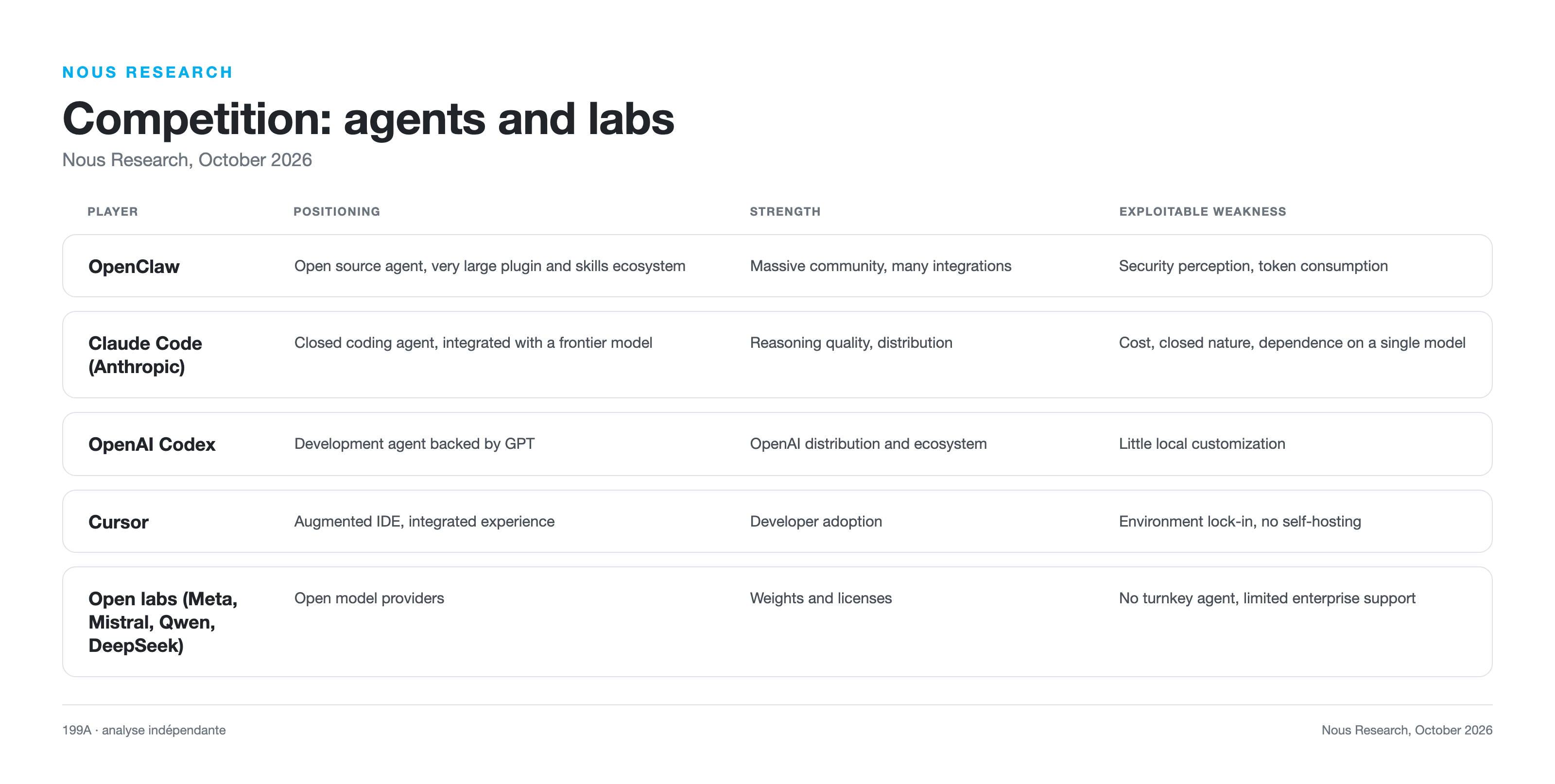
The most direct competitor is OpenClaw, the other reference open source agent, with which Hermes Agent is regularly compared, sometimes to the point that the documentation of both projects cite each other. Against it, Nous Research emphasizes token frugality, stability and deeper integration with its own models.
Against the closed players, the argument is different: it is not raw power, but control. A Hermes Agent user can change models, host their data, keep their memory and skills, and migrate to another provider without losing everything. It is a promise of individual sovereignty and, for a company, a compliance argument.
The most singular position remains Nous Portal: by reselling access to its competitors' models, Nous Research places itself above the fray. It becomes the neutral intermediary that allows comparison, switching and budgeting, a role that neither Anthropic nor OpenAI can play, since they sell their own models.
What to watch
Four signals will tell, over the next twelve months, whether Nous Research succeeds in its pivot.
- The first major enterprise contract made public. A name, an amount, a duration: proof that "Hermes for Businesses" exists commercially.
- The launch of the mobile app. It will tell whether Nous Research wants to remain a developer tool or become a mainstream assistant.
- A Psyche training run at frontier scale. Going from 36 to several hundred billion parameters in a distributed setting would validate the thesis.
- The publication of a security report or a certification. SOC 2, code audits, disclosure policy: proof that the company takes trust seriously.
Three scenarios are on the table. The most favorable: the company adopts the agent, the Portal becomes the gateway, Psyche lowers costs, meaning more than 200 million dollars in ARR by 2028. The central scenario: real but slow enterprise growth, 100 to 150 million in ARR, and a respected lab with a solid commercial activity. The least favorable: frontier models commoditize the agent, regulation makes open source more expensive, and the valuation contracts. These are not forecasts: they are the three hypotheses that the known facts allow us to hold.
Sources
- Nous Research, A Note on Our Fundraise, 7 octobre 2026.
- Nous Research, Introducing Hermes 4.3: Local Intelligence Globally Trained, 1er décembre 2025.
- Nous Research, Hermes Agent, documentation, consultée le 28 octobre 2026.
- Nous Research, Nous Portal, documentation, consultée le 28 octobre 2026.
- Hermes Agent, About, 2026.
- GIGAZINE, The open-source AI agent Hermes Agent has been downloaded more than 24 million times, 8 octobre 2026.
- TechCrunch, Hermes agent maker Nous Research in talks for new funding at $1.5B valuation, 13 juillet 2026.
- The Block, Decentralized AI project Nous Research in talks to raise $75M at $1.5B valuation, 14 juillet 2026.
- Fortune, Crypto VC giant Paradigm makes $50 million bet on decentralized AI startup Nous Research, 25 avril 2025.
- Tech Funding News, Nous Research raises $90M at a reported $1.5B valuation, octobre 2026.
- FinSMEs, Nous Research Raises USD90M in Funding at USD1.5 Billion Valuation, octobre 2026.
- The Next Web, Nous Research raises $90M to take its Hermes AI agent to businesses, octobre 2026.
- Plain AI, He Studied Religion. Then He Built the Most Uncensored AI Models in the World, 30 mai 2026.
- Plain AI, The Nous Co-Founder Nobody Talks About, We Found the Trail, 30 mai 2026.
- Plain AI, Nous Research, fiche startup et fondateurs, mai 2026.
- YesPress, Dillon Rolnick, The Trader Betting on Open AI at Nous Research, 2026.
- ThursdAI, Fiche invité : Dillon Rolnick, mai 2025.
- TBPN Digest, Nous Research launches Hermes agent and hackathon, 4 mars 2026.
- FundedIQ, Nous Research: Funding, Investors & Team, octobre 2026.
- StartupHub.ai, Shivani Mitra, Co-founder at Nous Research, septembre 2026.
- WeAreDevelopers, Hervé Bizira, profil intervenant, 2026.
- GitHub, API du dépôt NousResearch/hermes-agent, 28 octobre 2026.
- OpenRouter, Hermes 4 405B, fiche modèle, 2026.
- VentureBeat, Nous Research drops Hermes 4 AI models that outperform ChatGPT without content restrictions, août 2025.
Author's note
- Commissioning and framing: James AUDRY SPENCER.
- Execution: DeepSeek Flash (
deepseek-flash, providerdeepseek-official, maximum reasoning effort). - Production time: 22 min 50 s (October 28, 2026, 16:09:49 → 16:32:39, Paris time).
- Tokens: 197,184 input tokens excluding cache, plus 40,571,136 read from cache, for a total of 40,768,320 tokens processed; 156,524 output tokens, reasoning and tool calls included.
- Scope: 175 agent steps, 24 sources.
This article was compiled from open sources: Nous Research press releases and documentation, general and specialized press, funding databases, GitHub API. No direct interview with the company was conducted. The traction figures put forward by Nous Research are not audited; discrepancies between sources (Hermes Agent launch date, headquarters, total raised) are flagged in the text. English quotations have been translated; biographical gaps are made explicit rather than filled in.
Independent article, unaffiliated with Nous Research. Written on October 29, 2026.